The local cooling rules for rentals
Phoenix city code sets a cooling standard for residential rental units that have cooling equipment. Under Phoenix City Code §39-5, a unit with air conditioning must be able to keep habitable rooms at or below 82°F, and a unit with evaporative cooling at or below 86°F, measured three feet above the floor in the center of the room.
The Arizona Attorney General has reminded landlords that Phoenix and Tucson both have an 82°F standard for air-conditioned rentals and that the Arizona Residential Landlord and Tenant Act sets repair duties. The Arizona courts self-service center has a plain page on air conditioning issues. Check the current code text with your own counsel; this is general information, not legal advice.
Commercial buildings such as offices and retail are a different set of rules, but the pressure is similar. Tenants call, and a cooling failure in summer shuts down a space fast.
The spring checklist
The ENERGY STAR maintenance checklist recommends a pre-season check of cooling equipment by a contractor in the spring. For a commercial or multifamily portfolio in the Valley, that means getting on the calendar before your HVAC vendor is fully booked.
Rooftop and split systems
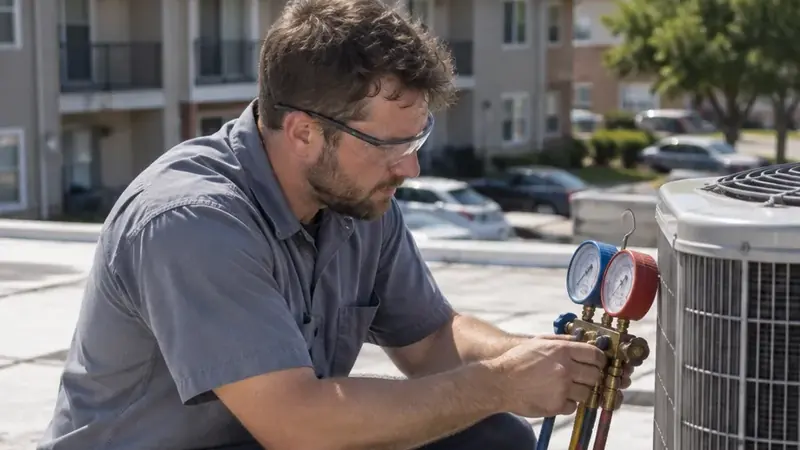
- Clean condenser coils. Dust and debris on coils make the system work harder in the heat.
- Check refrigerant charge and look for leaks.
- Test capacitors, contactors and electrical connections, which take a beating in high heat.
- Check fan motors, belts and bearings.
- Clear condensate drains and pans so they do not back up into ceilings.
- Verify thermostat settings and controls.
Evaporative coolers
Many older Valley properties still run evaporative coolers. Replace pads, check the water supply line and float, clean the reservoir and check the pump before the season starts.
Filters, on a shorter cycle
ENERGY STAR suggests checking filters monthly. In Phoenix and Tucson, dust is a bigger factor than in many places, so plan for more frequent changes during the season.
Plan for monsoon on top of the heat
The National Weather Service treats June 15 to September 30 as monsoon season in Arizona, with dust storms, high winds and heavy rain, per its monsoon safety page. The City of Phoenix publishes monsoon resources as well. For HVAC, that means:
- Filter changes after major dust storms, not just on the calendar.
- A check of rooftop units after high winds for loose panels and damaged condenser fins.
- Power surges and outages that can trip or damage equipment.
Check the vendor, not just the equipment
License with the Arizona ROC
HVAC contractors in Arizona are licensed by the Registrar of Contractors. Look up the license, check that it is active, and check that the classification matches the work, using the ROC contractor search. The ROC lists its license classifications online.
Refrigerant certification
Technicians who service equipment with refrigerants must hold EPA Section 608 certification, per the EPA. Ask your vendor to confirm their techs are certified.
Insurance and workers' compensation
Ask for a current certificate of insurance and add your property as additional insured if your agreement requires it. Arizona generally requires employers to carry workers' compensation for their employees, per the Industrial Commission of Arizona.
A written scope of service
Put the maintenance visit in a short written scope before the season: which units, how many visits, what each visit covers, how filters are handled, and how the vendor reports what they found. A one-page report per building, with photos of coils and drains and a list of parts that are close to failing, gives you a repair budget before summer instead of during it. It also gives the next vendor a starting point if you ever need to switch.
A stated response time
Ask every HVAC vendor what their response time is for a no-cool call in July, in writing. Then ask what happens when they have more calls than techs.
Have a backup on file
The HVAC company you have used for years can still be days out during a long heat stretch. A second vendor, with license and insurance already checked, is the difference between a same-day fix and a tenant without cooling while you make calls. Put the backup on file in April, not in July.
OnRoster is live in Phoenix and Tucson. Managers can set up a free roster with an HVAC primary and backup on file, and text the desk when a no-cool call comes in. HVAC contractors can check the HVAC trade page.
Questions managers ask
What temperature must a Phoenix rental be cooled to?
Under Phoenix City Code §39-5, residential rental units with air conditioning must be able to keep habitable rooms at or below 82°F, and units with evaporative cooling at or below 86°F. Check the current code and your counsel for your property.
When should Phoenix properties schedule HVAC maintenance?
In spring, before the summer heat and before HVAC contractors are fully booked. ENERGY STAR recommends a pre-season cooling check each spring.
How often should filters be changed during monsoon season?
ENERGY STAR suggests checking filters monthly. In the Phoenix and Tucson area, plan for more frequent checks and a change after major dust storms.
How do I check an HVAC contractor's license in Arizona?
Use the Arizona Registrar of Contractors search to confirm the license is active and that the classification matches the work.
Does OnRoster do HVAC work?
No. OnRoster is a vendor desk run by Inertia Management. We keep contractors with paperwork on file and route your request. You decide who you hire.
Sources
- Phoenix City Code §39-5
- Arizona Attorney General: landlord obligations on cooling
- Arizona courts: air conditioning issues
- ENERGY STAR: maintenance checklist
- NWS Tucson: monsoon safety
- City of Phoenix: monsoon resources
- Arizona Registrar of Contractors: before you hire
- EPA: Section 608 refrigerant management
- Industrial Commission of Arizona: employers
General information, not legal, insurance or tax advice. Rules change; check the source and your own advisers for your property. OnRoster is a vendor desk run by Inertia Management. We are not a contractor and do not perform work.